The "Junk Lead" Myth
If you run a local service business, a real estate brokerage, or an e-commerce brand, you have almost certainly experimented with Meta (Facebook/Instagram) Lead Ads. The pitch is irresistible: instead of forcing users to click a link, wait for your slow website to load, and type out their contact info on a tiny mobile keyboard, Facebook auto-fills their details into a native popup form. Two taps, and you get a lead for $3.
But within two weeks of launching the campaign, every single sales rep in your company will start complaining. "These leads are garbage," they will say. "Half of them don't pick up the phone, and the other half claim they never filled out the form."
This is one of the most persistent myths in digital marketing. Facebook Lead Ads do not inherently produce "junk." The problem is entirely rooted in your backend processing speed and your lack of automated qualification infrastructure. If you are downloading a CSV from Facebook's Ads Manager 24 hours after the lead was submitted, you have already lost.
The Danger of Frictionless Forms
The greatest strength of a Facebook Lead Ad is also its greatest weakness: it is entirely frictionless. Because Facebook auto-fills the user's name, email, and phone number based on their profile data, a user scrolling mindlessly on their couch at 10:00 PM can submit your form without exerting any mental effort whatsoever.
Because they exerted zero effort, their intent is incredibly low, and their memory of the event is fleeting. If you call them the next afternoon at 2:00 PM, they will genuinely have no idea who you are or why you are calling them.
Adding Friction Intentionally
To immediately improve lead quality, you must add intentional friction to the form. Do not just ask for the auto-filled name and email. Add one custom, multiple-choice question that requires the user to manually tap an answer. For example: "When are you looking to purchase? (A) ASAP (B) In 3 months (C) Just browsing." This simple micro-commitment weeds out the accidental clicks and forces the user to mentally engage with your offer.
Webhook Architecture Explained
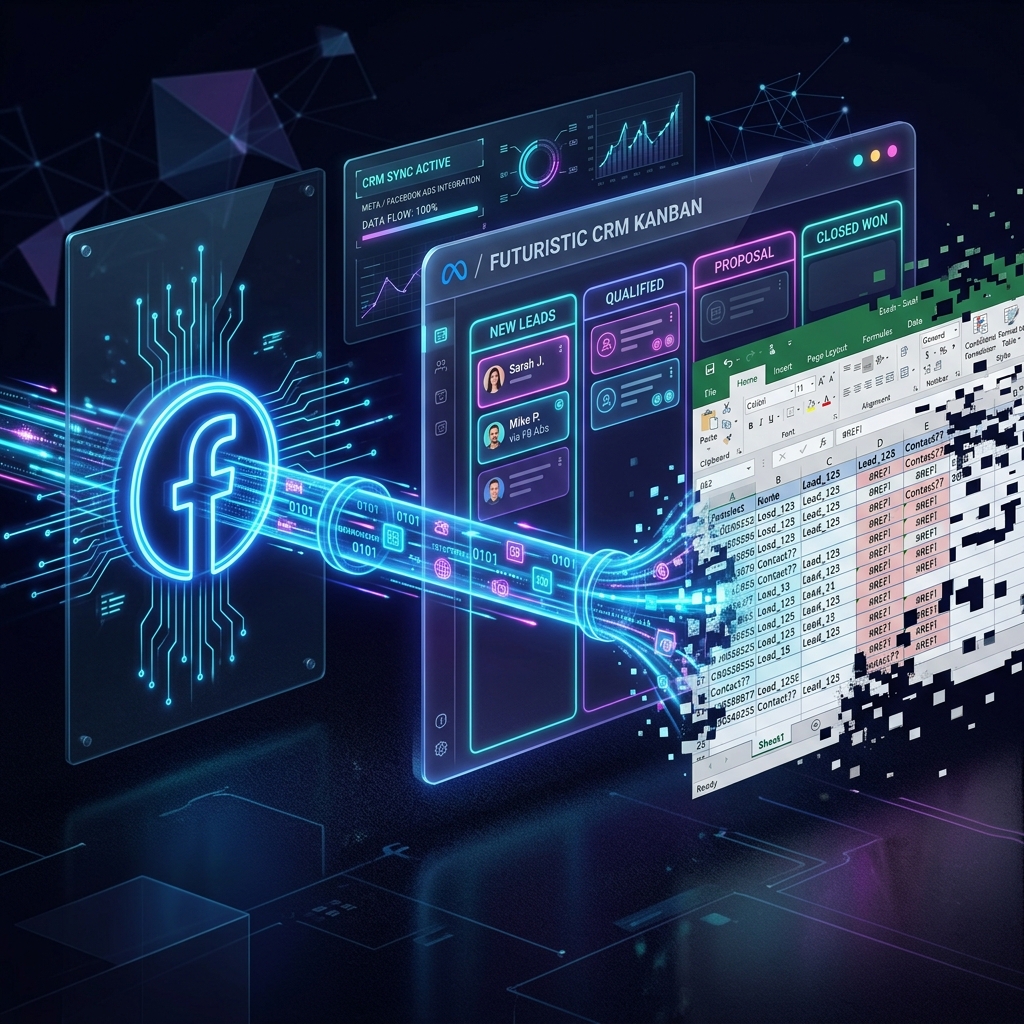
To solve the speed problem, you must banish the manual CSV download process forever. You need to connect Facebook directly to your CRM via a Webhook or an API integrator like Zapier or Make.com.
A webhook is simply a way for two applications to communicate in real-time. When a user hits "Submit" on the Facebook app, Facebook instantly fires a packet of JSON data to a specific URL provided by your CRM.
Within milliseconds, the CRM parses that data, creates a new Contact Card in the "New Inbound Leads" column of your visual pipeline, and triggers a cascading sequence of automated actions. The human delay is completely removed from the equation.
The Instant SMS Qualifier
Once the webhook drops the lead into your CRM, you must deploy the "Instant SMS Qualifier."
Because the lead is currently sitting on their couch looking at their phone, you have a 60-second window to cement your brand in their brain. The CRM should automatically text them:
"Hi John, thanks for requesting a quote for the solar installation! Our lead tech, Mike, will call you from this number in about 5 minutes. Does that work for you?"
This text accomplishes three critical things:
1. It immediately validates that their form submission worked.
2. It prepares them to receive an incoming phone call from an unknown number.
3. It forces a micro-commitment (a "Yes" reply) which dramatically increases the connect rate when Mike actually calls 5 minutes later.
Cleaning the Facebook Pixel
Finally, advanced CRM integration allows you to feed conversion data back into the Meta algorithm. This is known as the Conversions API (CAPI).
If Facebook sends you 100 leads, but only 10 of them actually end up paying you money, Facebook's algorithm doesn't know that. It thinks it did a great job by getting you 100 cheap leads, so it will go find more people exactly like the 90 people who wasted your time.
When your sales rep drags a lead card into the "Closed/Won" column in your CRM, the CRM must send a webhook back to Facebook saying: "THIS specific person actually bought the product. Find more people who look like THIS." Over the course of a month, the algorithm becomes hyper-optimized, driving higher quality traffic and completely eliminating the "junk lead" problem at the source.
Conclusion & Final Thoughts
Facebook Lead Ads are a goldmine, but only if you have the infrastructure to mine them. Stop blaming the traffic source for your operational bottlenecks. By wiring a CRM directly into your ad accounts, utilizing instant automated SMS, and feeding conversion data back to the algorithm, you can turn cheap social media traffic into a highly predictable revenue engine.
Want to understand how to build these complex webhook pipelines? Read my deep dive on orchestration: Architecting the 'Auto-Operator' via n8n.
Stop downloading CSVs.
NexDial integrates directly with Facebook and Instagram Lead Ads out of the box. The second a lead submits their info, they appear in your pipeline, and NexDial fires your automated qualification sequence instantly.
Start Your Free Trial Today