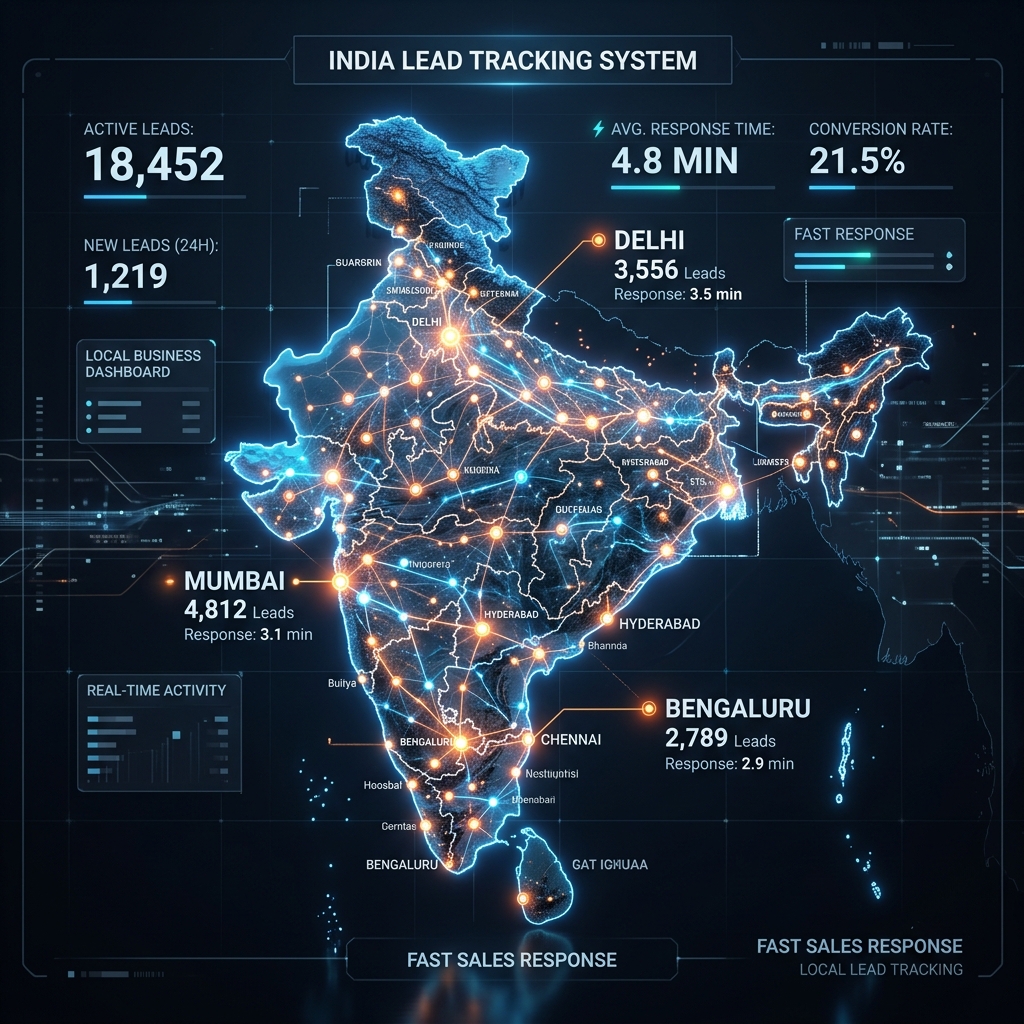
The Shift in the Indian Market
The Indian business landscape is undergoing an unprecedented digital transformation. Whether you are running a real estate brokerage in Mumbai, an insurance agency in Delhi, or a fast-growing IT services firm in Bangalore, the speed at which business is conducted has fundamentally changed. The modern Indian consumer and B2B buyer is hyper-connected, deeply researched, and expects immediate responses.
Just five years ago, you could get away with returning a prospective client's phone call the next morning. Today, if a user submits a lead form on your website or Facebook ad, and you don't call them within exactly five minutes, they have already opened a new tab, found your closest competitor, and booked a meeting with them. Speed to lead is no longer a luxury; it is the ultimate competitive advantage in the local market.
However, there is a massive disconnect between this demand for speed and the internal software infrastructure that most Indian small and mid-sized businesses (SMBs) actually use. While the marketing teams are running cutting-edge AI-optimized Meta campaigns, the sales teams are trying to manage the resulting influx of leads using software architectures built in 2010.
The Legacy Software Problem
For years, the "Standard Operating Procedure" for an Indian business looking to digitize its sales process was to purchase a license for a massive, legacy enterprise CRM. You know the names. These systems were originally designed for massive Fortune 500 corporations with armies of data-entry clerks and dedicated IT administration teams.
When a local business with a 15-person sales team tries to use these legacy platforms, chaos ensues. The interfaces are overwhelmingly complex. There are dozens of mandatory dropdown menus, clunky reporting dashboards, and confusing navigation paths just to log a single 3-minute phone call.
The Adoption Failure
When software is harder to use than the problem it is trying to solve, your employees simply will not use it. Sales reps in India are highly aggressive and target-driven. They want to be on the phone closing deals, not acting as data-entry typists. Because these legacy CRMs are so painful to use, adoption rates plummet. Reps start hoarding leads in their personal diaries or local Excel files, completely defeating the purpose of paying for a CRM in the first place.
The Great Indian Excel Trap
When the expensive enterprise CRM fails to gain traction, the business owner inevitably capitulates and reverts to the "Great Indian Excel Trap."
Spreadsheets are comfortable. Every college graduate knows how to use them. But running a modern sales team out of a shared Google Sheet or a local `.xlsx` file passed around via email is a recipe for catastrophic data leakage.
Spreadsheets are static. They do not notify your sales rep when a prospect opens an email. They do not send a push notification to a mobile phone when a high-value lead goes completely cold. They cannot automatically send a WhatsApp follow-up message if a deal sits in the "Negotiation" phase for more than a week. In a market where your competitors are automating their follow-ups, relying on a sales manager to manually filter an Excel sheet every morning to figure out who to call is like bringing a knife to a gunfight.
Visual Pipelines Explained
This massive friction is exactly why forward-thinking Indian businesses are rapidly abandoning both legacy CRMs and spreadsheets in favor of modern, **Visual Kanban Pipelines**.
A visual pipeline completely changes the psychological paradigm of how a sales rep interacts with their data. Instead of looking at a terrifying grid of 500 rows and 20 columns, the sales rep looks at a clean, intuitive board divided into vertical stages representing your exact sales cycle:
- Stage 1: New Inbound Leads (Auto-populated from Facebook/Website)
- Stage 2: Contacted / Discovery Done
- Stage 3: Proposal Sent / Pricing Discussed
- Stage 4: Negotiation / Follow-up Required
- Stage 5: Won / Deal Closed
Every single customer is represented as a digital "Card." As the relationship progresses, the rep simply clicks and drags the card from left to right. This drag-and-drop interface is so intuitively satisfying that it actually gamifies the sales process. Reps *want* to move the cards to the "Won" column.
More importantly, a visual pipeline provides instant managerial clarity. A sales director can open the dashboard, take one glance, and immediately say: "We have 40 leads stuck in the Proposal Sent stage, but only 5 in Negotiation. Our pricing might be too high, or our reps aren't following up fast enough." You cannot get that level of instantaneous, surgical insight from an Excel sheet without running complex pivot tables.
Mobile-First Execution
Another critical factor driving this shift is the reality of the Indian sales environment: it is highly mobile. Real estate brokers, insurance agents, and B2B field reps are constantly stuck in traffic, jumping between client offices, and sitting in coffee shops.
Legacy CRMs are notoriously terrible on mobile devices. Trying to update a complex enterprise software form on a 6-inch smartphone screen while sitting in an auto-rickshaw is an exercise in pure frustration. Modern visual CRMs are built to be mobile-first. A rep can finish a client meeting, pull out their phone, drag the client's card to the next stage, type a two-sentence voice-to-text note, and put the phone back in their pocket in under 15 seconds.
Data Localization and Security
Finally, as the Indian regulatory environment matures with new data privacy bills, local businesses can no longer afford to be cavalier with customer data. Keeping thousands of customer phone numbers and financial details in unprotected Excel files stored on a junior rep's personal laptop is an enormous liability.
Modern cloud CRMs offer robust role-based access control (RBAC). A business owner can easily ensure that a junior sales rep can only view and export the 50 leads assigned to them, while the regional manager has visibility over the entire territory. If a rep leaves the company, their access is revoked with a single click, ensuring your proprietary client list doesn't walk out the door with them.
Conclusion & Future Outlook
The Indian market is too competitive to tolerate operational friction. You cannot afford to lose high-value deals simply because your software was too annoying for your reps to use. By upgrading to a clean, highly visual CRM pipeline, you eliminate the administrative burden, rescue your lost leads, give your management team crystal-clear visibility, and build a scalable infrastructure that can actually support your growth ambitions.
For more deep technical insights into scaling technology infrastructure in our local market, check out my complete blueprint: The 2026 Strategic BI Guide: Scaling Automated Reporting Solutions in the Indian Market.
Upgrade your infrastructure.
Stop wrestling with legacy software and terrifying Excel spreadsheets. NexDial provides Indian businesses with incredibly intuitive, drag-and-drop visual pipelines designed specifically for high-velocity, mobile-first sales teams.
Start Your Free Trial Today