The Myth of the One-Call Close
In the world of B2B sales, there is a dangerous mythology surrounding the "One-Call Close." We all love the story: a brilliant sales rep gets on a discovery call, completely mesmerizes the prospect with a pitch-perfect presentation, handles all objections with surgical precision, and secures a signed contract right there on the Zoom call.
It's a fantastic story. It's also complete fiction for 99% of modern businesses.
In reality, B2B sales in 2026 is a complex, multi-stakeholder ecosystem. Buyers are highly educated, immensely skeptical, and fiercely protective of their budgets. They do not buy enterprise software or high-ticket services on a whim. The journey from "Initial Interest" to "Signed Contract" is a long, winding road paved entirely by persistent, methodical follow-ups. If your sales team is relying on their charm to close deals on the first call, you are leaving an astronomical amount of revenue on the table.
The Psychology of Silence
Here is a terrifying statistic for any sales director: 44% of salespeople give up after exactly one follow-up call. If the prospect doesn't answer the phone or reply to the first "just checking in" email, the rep marks the lead as "Dead" in their spreadsheet and moves on to the next shiny new prospect.
Why do reps quit so incredibly early? The answer lies in basic human psychology. Rejection hurts, and humans are hardwired to avoid pain. When a rep sends three emails and gets absolute silence in return, their brain automatically interprets that silence as hostility. They assume the prospect hates them, is annoyed by them, and actively wants them to go away.
But you have to train your team to reframe this psychology. In the corporate world, silence is rarely malicious. Your prospect is a busy executive. They are putting out operational fires, dealing with HR complaints, fighting with their own vendors, and attending back-to-back endless meetings.
The Executive Mindset
When an executive sees your second email, they probably think, "Oh right, I really need to reply to this," but then their Slack pings with an urgent message, and your email is instantly forgotten. Professional persistence isn't annoying; it's a valuable service. You are politely keeping your solution at the top of their inbox until they finally have 5 minutes of breathing room to engage with you.
The Five Follow-Up Rule
The data on sales conversions is incredibly clear, and it has remained consistent for years. According to industry-wide analytics, 80% of successful sales require at least FIVE continuous follow-up calls or touchpoints after the initial meeting.
Read that again. 80% of your revenue requires five touches. Yet, nearly half of your sales reps quit after touch number one. This massive gap between what is required to win and what reps are actually doing is where your company is bleeding cash.
If your marketing team spends $200 to acquire a qualified lead, and your rep gives up after one phone call, you are literally setting money on fire. You are paying for the privilege of warming up a prospect so that your competitor—who actually has the discipline to follow up 6 times—can close the deal a month later.
Structuring Your Follow-Up Cadence
The key to a successful follow-up sequence is understanding that it cannot just be you saying "Just checking in!" or "Did you see my last email?" five times in a row. That actually *is* annoying, and it will get you blocked. Every single touchpoint in your sequence must provide net-new value to the prospect.
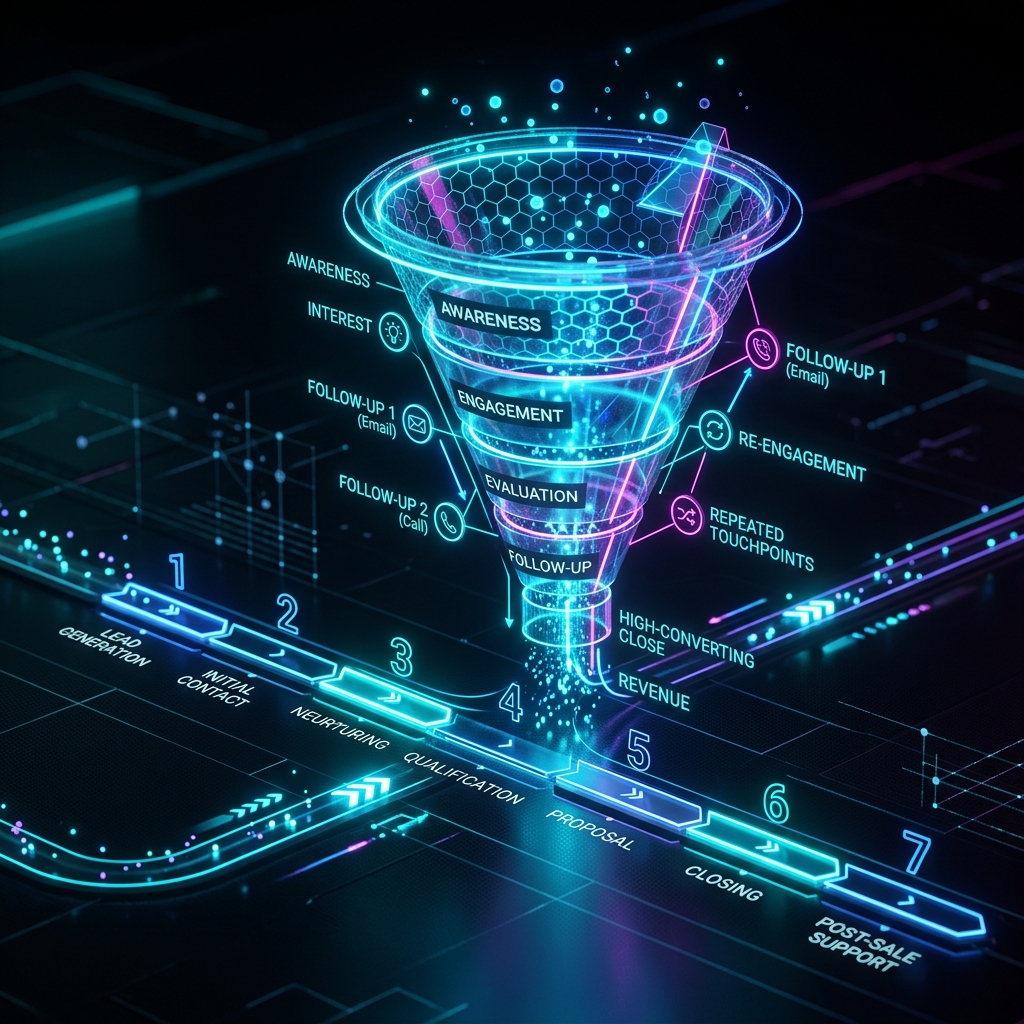
We call this a Value-Driven Cadence. Here is exactly how a high-performing 7-touch sequence should look:
- Touch 1 & 2 (Day 1 - The Double Tap): The immediate follow-up. An email summarizing the discovery call with the core value proposition, immediately followed by a quick phone call (if they don't answer, do not leave a voicemail yet).
- Touch 3 (Day 3 - The Proof): An email sharing a highly relevant, deeply specific case study. "Hey John, I know you mentioned struggling with inventory tracking on Tuesday. Here is a brief 2-page PDF on how we solved that exact issue for a competitor in your space."
- Touch 4 (Day 5 - The Voice): A polite phone call. This time, leave a 15-second, high-energy voicemail. Reference the email from Day 3.
- Touch 5 (Day 7 - The Pivot): A LinkedIn connection request with a personalized note. You are engaging them on a different platform to bypass the cluttered email inbox.
- Touch 6 (Day 10 - The Demo): A short email with a customized, 60-second Loom video walking through a specific software feature that solves their exact pain point. Visuals convert.
- Touch 7 (Day 14 - The Break-Up): The final "Break-up" email. "John, it seems like fixing the inventory system isn't a priority for your team right now, so I will stop reaching out. Let me know if things change down the road." Ironically, this email often gets the highest reply rate because it triggers a psychological fear of missing out.
The Role of CRM Automation
Now, let's look at this from a managerial perspective. You cannot expect human sales reps to manually remember to execute a highly complex, 14-day, 7-touch sequence across 50 different prospects simultaneously.
If they have to track "Who gets the Day 5 voicemail today?" using a notepad or an Excel spreadsheet, they will fail. It is mathematically impossible to maintain that level of administrative discipline without software.
This is why a modern CRM is non-negotiable. You must use software to automate the cadence. When a lead enters the "Follow-Up" stage, the CRM should automatically send the Day 3 case study email while the rep sleeps. On Day 5, the CRM should ping the rep's phone with a push notification saying: "Call John Doe right now." By outsourcing the memory and the administration to a machine, the human rep is freed up to do what they do best: build rapport on the phone.
Omnichannel Persistence
Furthermore, modern follow-ups require an omnichannel approach. Sending 7 emails is easily ignored by spam filters. But sending an email, leaving a voicemail, connecting on LinkedIn, and sending a quick WhatsApp message creates a surround-sound effect.
A great CRM tracks all of these touches in a single, unified timeline. Before your rep makes that Day 5 phone call, they can look at the timeline and see exactly when the prospect opened the Day 3 email, giving them incredible conversational leverage.
Conclusion & Final Thoughts
Sales is a game of attrition. The companies that win are not necessarily the ones with the most charismatic salespeople; they are the companies with the most relentless, systematic, and automated follow-up infrastructures. Stop letting your reps quit on Day Two. Build the machine, enforce the cadence, and watch your conversion rates explode.
Want to read more about the intersection of psychological intent and data-driven execution? Read my deep dive on Exploring the Psychology of High-Fidelity Dashboard Design to see how we build systems that drive human action.
Automate your persistence.
Don't leave your follow-ups to chance. NexDial allows you to program multi-touch, omnichannel cadences directly into your visual pipeline, ensuring your sales reps never drop the ball again.
Start Your Free Trial Today